Monday, August 28, 2023

Social Semiotics


    Social Semiotics is in basic methodology a study of communication and how people communicate in different social settings.  While semiotics on its own focuses on signs and symbols, social semiotics attempts to explain the meaning of these signs and symbols in human to human interaction.  One of the founders of the concept, Ferdinand de Saussure described social semiotics as "the science of the life of signs in societies" The purpose of studying social semiotics is not just to get an understanding of people in general, but also an understanding of cultural insight and critical thinking as well. 


Social Semiotics can best be described by following these ten concepts:

1) Signs and Symbols - This is central to semiotics to begin with.  They can involve words or pictures that someone can visualize to some sort of degree

2)  Multimodality - How different modes like language, sounds, gestures, and images work together in order to create meaning

3) Semiotic Resources - Words, grammar, images, color, sounds, music.  These are the visual

4)  Contextual Meaning - Social, cultural, and situational context can determine content

5) Intertextuality - Text that is influenced by quotes or other existing forms of text

6) Ideology - Some signs and symbols can influence those with particular beliefs, especially those with religious and political ideals

7) Genre and Discourse - News articles, books, Academic articles, and Advertisements have their own rules when it comes to communication

8) Visual Grammar - Composition, framing, perspective, and the use of color and symbols.

9) Agency and Reception - How individuals and communities produce and interpret signs and symbols

10) Critical Analysis - The questioning of assumptions and power structures


You can use Social Semiotics when observing images to get a better understanding of what is going on if you take any of the ten concepts above into consideration


Sad girl looking away alone on the beach Stock Photo | Adobe Stock

Take this stock photo of a woman for example.  She appears depressed.  You can tell because of her body language, darker colors, and the gloomy weather in the background, which further adds symbolism to the depressing atmosphere.  


Happy Girl Quotes Wallpapers - Wallpaper Cave

Or how about this photo?  This woman appears more happy.  You can tell the message for this photo is meant to be more uplifting both with the brighter colors, the woman's body language, and the quote by Omar Khayyam inserted into the image.


Even internet memes fall under social semiotics, as they serve as a means of online communication usually to convey a sort of message whether its to promote laughter, a cause, critique, etc.     (https://www.tandfonline.com/doi/full/10.1080/10350330.2017.1303020?src=)The memes! | Metal Gear Rising: Revengeance | Know Your Meme

Monday, August 21, 2023

Digital Smackdown: How A Toxic Business lost to trolls


There's a saying on the internet: "Do not Argue with Trolls, it means they win". 

Through time and time again, we've seen arguments break out real quick on the net ranging from serious discussions to not so serious discussions.  

Most of the time, trolls exist for the sole purpose of spreading chaos and get a reaction out of its intended victims for a multitude of reasons.  In some cases, the trolls may even call out the actions of those who deserve criticism.  For example: I'd like to discuss the downfall of a family business called Amy's Baking Company, because it is an example of how one shouldn't act in an online argument.

Amy's Baking Company was a family owned restaurant in Arizona owned by Amy Bouzaglo and her husband Samy.  Their restaurant was featured in an episode of Gordon Ramsay's Kitchen Nightmares.  Viewers and Ramsay himself were displeased to learn the conditions of how the restaurant was being run.  Patrons found themselves waiting too long for service and the owners were pocketing any tips earned by their servers, whom were often fired, especially if they spoke out.  For a show that prided itself on helping struggling restaurants improve, Ramsay admitted there was no fixing a business if the owners didn't change their ways.  The episode drew the attention of online trolls, who took to social media, leaving one-star reviews, criticizing the Bouzaglo Family for their business practices, and others simply were looking to poke some chaos into a situation.  

Regardless of the criticism, The Bouzaglos broke a huge rule when it came to dealing with trolls: They went on the offensive and made fools of themselves in an explicative post on their company's Facebook page, cursing out their critics and reveling in their own arrogance.

Needless to say, that post only made their situation much worse.  Instead of having a calm and educated argument, or even taking the words of their critics into perspective, the Bouzaglos reacted negatively and made no effort in arguing their side.  They gave the trolls what they wanted and rather than solve the problem, they got what they deserved.  Critics responded by digging up information about the Bouzaglos and without hesitation, weaponized it against them, forcing their business to shut down and had Samy Bouzaglo deported because of his criminal record. (https://www.reputationdefender.com/blog/orm/4-examples-of-online-fights-that-caused-permanent-reputation-damage)

The sad thing is, the whole situation could have easily been avoided if the Bouzaglos would have chosen to listen to the criticism coming their way.  Because for the most part, the criticism against them was warranted, and even if it wasn't true.  Let's just assume for a moment that Ramsay was wrong and they were hypothetically this upstanding business with zero problems.  It still wouldn't mean the Bouzaglos were correct in their response.  Rather, there are five basic guidelines I can think of when it comes to arguing on the internet

  1. Keep it relevant.  If you are arguing, don't branch into something else unless it is related to the argument
  2.  Refrain from using hateful language.  Even if the individual you are arguing with is being hateful
  3. Keep your cool.  It may be difficult, but the best way to deal with a troll is not to react negatively
  4. Back up your own side with factual evidence that is difficult to refute.  The more sufficient data you have to offer, the stronger your side becomes.  
  5.  Don't ever contribute to making a conflict worse. The last thing you want to do is make your side appear as the bad guys. 
It might seem little, but it is the least we can do to help create a less toxic environment in cyberspace.  Think of it this way: Online or offline, how do you want to be seen by your peers?  As someone who spreads animosity or a respectable leader that can bring people together?


Friday, August 18, 2023

Toulmin Method


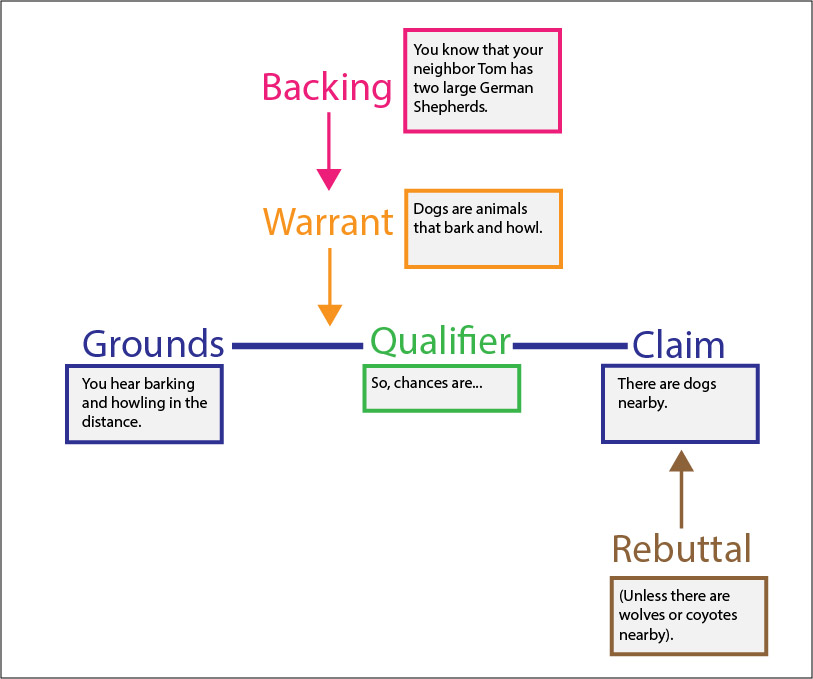
The Toulmin Method is a model of debate divided into six main components:


  1. Claim: The central assertion or propisition 
  2. Data: The evidence that supports the claim
  3. Warrant: The assumption that connects the data, explaining why it is relevant
  4. Backing: Additional evidence that provides context to the claim
  5. Qualifier: Indication of degree of certainty of claim
  6. Rebuttal: Addresses counterarguments

Using the Toulmin Method, let's apply it to the vaccine debate as an example:

Claim: Vaccines are a vital tool in combatting the outbreaks of deadly diseases

Data: Statistics from medical organizations such as the CDC show rates at which vaccinations reduce infection.

Warrant: For this, we can bring up the concept of herd immunity and how vaccinations contribute towards it

Backing: Trustworthy Scientific studies can be cited to provide further support of how effective vaccines are

Qualifier: Acknowledge the side effects of vaccines, but point out the low occurance and how they often are not dangerous in contrast to the disease the vaccine in question is combatting

Rebuttal: Address the concerns about the safety of vaccinations by pointing out how all vaccines go through a rigorous approval process prior to being made available to the public

Now there are limitations to the Toulmin Method as well one should take into consideration such as Echo Chambers and information overload.  For the former, we often prefer to surround ourselves with like minded individuals who are more likely to agree with us, which why wouldn't we?  It's easier to discuss things with those who probably hold the same viewpoint.  And for the latter, some of us tend to share too much information, making it sometimes difficult for others to retain information.   
To help navigate these challenges, we should consider taking debates to a more public platform whenever we see opportunity, which means potentially discussing our viewpoints with those who may not agree.  We should participate in debates to get our viewpoints across and patiently hear out the opposition's side as well, even if we 100% disagree with them.  We as a society require constructive discussions as a means of improving communication between one another, especially when it comes to sharing ideas.    


Thursday, August 10, 2023

The Art of Listening


    Recently I started listening to Lewis Howes' podcast.  In the episode I listened to, Lewis is interviewing Transformation Coach Chris Lee, who goes over how powerful listening can be.

  Chris Lee on The School of Greatness


    Many of us often communicate via text or private messaging through social media applications.  As useful as this can be, text based communication does not always convey what one wishes to say to another.  It is more preferable to use verbal communication or communicate face to face, even if it is via phone or video chat.  You can't really listen to text.  Sure it is a form of communication, but at the end of the day, words are simply words.  But once you put a voice behind those words, it adds to the quality of communication.  

    There are 10 tools when it comes to listening:

    1. Be open
    2. Create a space to listen
    3. Have the person you're listening to feel important 
    4. Listen to their words
    5. Connect to their emotions
    6. Know what questions to ask
    7. Repeat back what you heard
    8. Honor the request made of you
    9. Identify the kind of person you're talking to
    10. Listen to yourself

    Listening is without a doubt a key factor when it comes to communication, especially if it is with somebody you have either a close bond with or if its in a more formal environment, such as with  supervisor or boss at work.  As Chris Lee put it at the beginning of the podcast, "Listening is the key to successful relationships."   

Thursday, August 3, 2023

The Battle for Public Opinion


Public Opinion Definition and Examples

https://www.thoughtco.com/public-opinion-definition-and-examples-5196466    


The internet, especially via social media has become a sort of hub for public opinion all over the world.  This rapid dissemination has erupted both in positive aspects and negative aspects as well.  

    On the one hand, this outlet has helped with the build up of progressive movements such as #MeToo and Black Lives Matter, both of which aim to spread awareness and put a stop to sexual abusers and corrupt police officers.  Through the creations of blogs, social media pages, and sometimes even full on websites, communities have created means to help individuals in common organize events.  On the other hand, the same could be said for groups of individuals with not as good intentions, such as the terrorists who attacked the U.S Capitol, or hateful organizations of individuals who prefer to harass and mistreat others.  On top of that in some cases, the issue at hand may not always be as black and white and there are many issues people may have different views on, and sometimes some of those views may not be even supported by the government.  

      The question at hand should be where do we draw the line?  And the problem here is that because of the First Amendment of the United States Constitution, we have freedom of speech, a right that while important, some individuals tend to abuse for their own personal gain.  We can't simply arrest people for being trolls or for their opinion, even if their words are harmful, unless said speech puts others in danger.  And while this might suck as it does protect internet trolls, this also prevents the government from silencing just about anyone for their words.  

    It's a tightrope to walk, but one thing social media can do to help filter out individuals with poor views is enforce the terms of services that we all have to agree to before we can finish making accounts.  If an individual's account is being used to harass others or promote hateful rhetoric, it should be reported and suspended, which is a right a social media company has thanks to the Terms of Services because it acts as a sort of contract between the individual and the company.  We as individuals can also block, report, and refuse to engage with those with toxic viewpoints as well.  Just because they have the right to share their shameful views does not mean we have to listen or adhere to them.  


Social Semiotics

       Social Semiotics is in basic methodology a study of communication and how people communicate in different social settings.  While sem...